Most organizations can tell you what they own. Far fewer can tell you where each machine is right now, how hard it has been worked and whether it is about to need attention. Asset intelligence is the practice of closing that gap: turning live data about your assets into decisions people can act on.
Key Takeaways
- Asset intelligence combines what an asset is, where it is, how it is being used and what condition it is in, in one record.
- It goes beyond asset tracking, which answers “where is it?”, and beyond asset management records, which answer “what do we own on paper?”
- It works as three layers: capture the data, keep it in one system of record, and act on it. Missing a layer leaves data nobody uses.
- The best starting point is a business question, not a sensor purchase.
What Does Asset Intelligence Mean?
An asset record on its own is a snapshot. It says a machine exists, who bought it and what it cost. It does not say whether the machine ran all week or sat idle, whether it moved to another site or whether its battery is slowly failing.
Asset intelligence adds that missing layer. Location, runtime, condition and history flow into the record automatically, so the record stays current without someone retyping it. The result is an asset list that behaves like a live view of operations rather than a spreadsheet that is out of date the day after it is updated.
How Is It Different From Asset Tracking and Asset Management?
The three terms overlap, which is why they get confused. A simple way to separate them is by the question each one answers.
- Asset tracking answers where an asset is.
- Asset management answers what you own, what it is worth and when it is due for maintenance, usually from records people maintain.
- Asset intelligence adds live usage and condition, so the record updates itself and points to what needs doing next.
Tracking is a feature of intelligence, and management records are its foundation. Intelligence is what you get when both are fed by current data. For a closer look at why record accuracy matters so much, see how to know if your asset data is actually accurate.
The Three Layers of Asset Intelligence
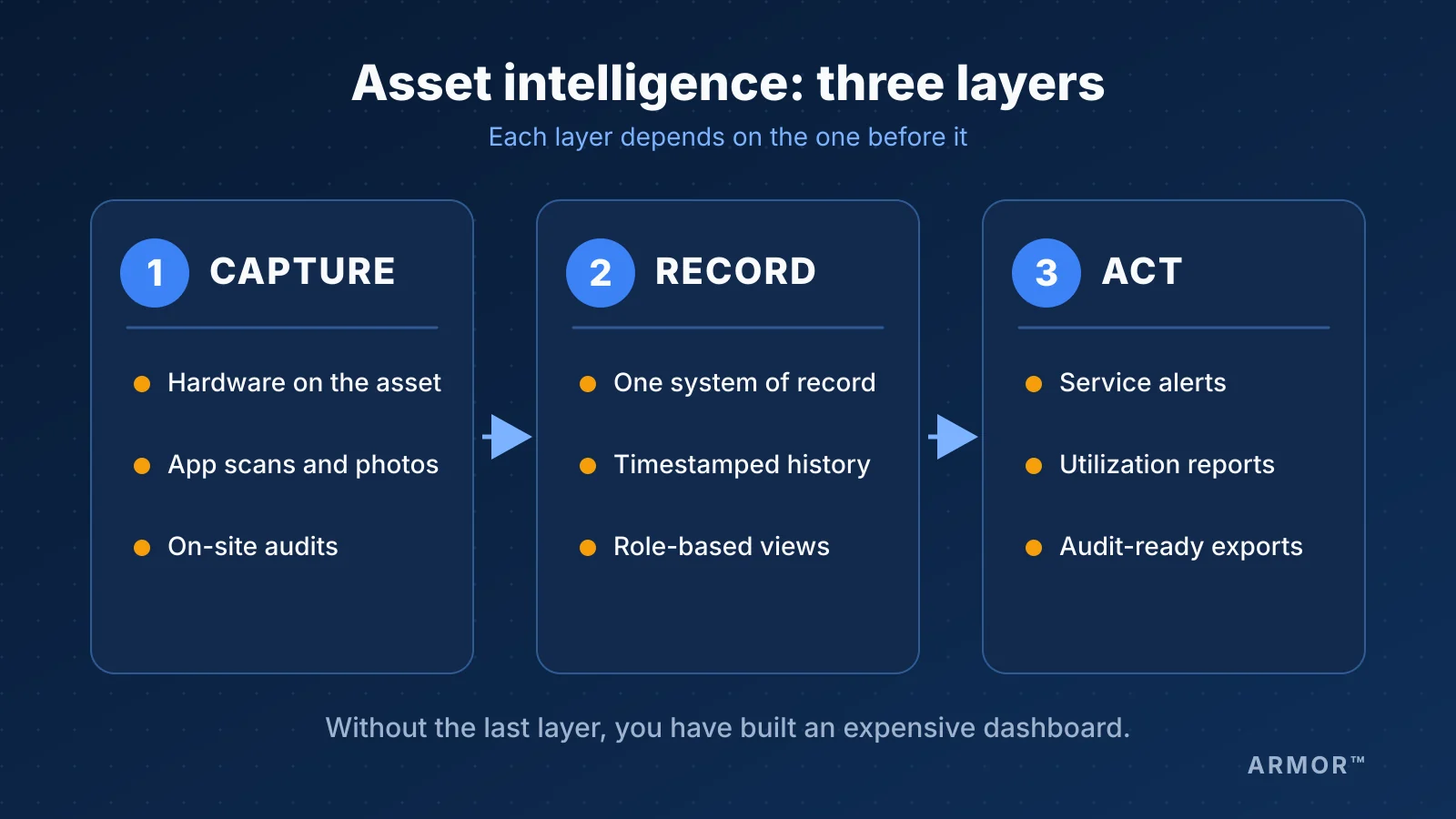
1. Capture
Data has to enter the system without manual effort wherever possible. That can be hardware on the asset that reports runtime, location and battery condition, a phone app that scans or photographs equipment during a walk-through, or both. Different assets justify different methods. A high-value machine that moves between sites earns a connected device. A shelf of tools may only need a tag.
2. Record
Captured data needs one place to live. A single system of record means operations, maintenance and finance are all looking at the same asset history rather than three competing lists. A timestamped history for each asset, with views suited to field technicians, regional managers and executives, is what turns raw readings into something a whole organization can use.
3. Act
The record only pays for itself when it prompts something: a service trigger when runtime crosses a threshold, a report showing idle equipment, an audit-ready export for finance. Without this layer, you have built an expensive dashboard.
What Questions Does Asset Intelligence Answer?
- Which machines are sitting idle, and which are working too hard? See how to calculate fleet utilization rate.
- Which assets are due for service, based on actual use rather than the calendar?
- Is it time to replace this machine? See when to replace equipment instead of repairing it.
- What does this equipment really cost across its life? See what total cost of ownership includes.
- Where is that machine now that it has left the building?
Where Should You Start?
- Pick one painful question. Lost equipment, surprise breakdowns and unreliable counts are common starting points.
- Build a verified baseline. Walk the assets, tag them and confirm the record. Building an accurate equipment inventory without spreadsheets covers how.
- Add live data where it changes a decision. Not every asset needs a device.
- Connect it to the systems people already use. The goal is to feed your existing tools, not to force a rip-and-replace.
Go Deeper
Once the basics are clear, three related guides take specific parts further:
- How asset intelligence gets smarter as you connect more equipment
- How to connect asset intelligence to maintenance, service and ordering
- How distributors can offer asset intelligence without building a platform
Where ARMOR™ Fits
The ARMOR™ platform is built around those same three layers. ARMOR 4+™, ARMOR Beacon™ and ARMOR Track™ capture runtime, location and condition data. ARMOR Asset Central™ keeps a timestamped record for every asset and flags service needs and replacement timing. The ARMOR Mobile App™ lets field teams photograph and tag equipment. ARMOR™ positions the platform as working alongside existing business systems, with no ERP replacement.
Frequently Asked Questions
Is asset intelligence the same as IoT?
No. IoT devices are one way to capture data, but asset intelligence also depends on the record and the actions that follow. Plenty of IoT projects collect readings that nobody uses.
Do I need a sensor on every asset?
Usually not. Match the capture method to the value and mobility of the asset. Scanning or tagging can cover low-value items, while connected devices make sense where live location or runtime changes a decision.
Does it replace my ERP or maintenance system?
It does not have to. The point is to feed accurate, current asset data into the systems your teams already rely on.
How is it different from telematics?
Telematics typically describes data from a machine’s own connected system, often tied to one manufacturer. Asset intelligence is the broader practice of bringing data from many assets into one record and acting on it.
Ready to see it on your own equipment? Start with the ARMOR Asset Central™ page, where you can start free with up to 100 assets.