There is a failure mode in exported equipment that most manufacturers never see coming, and it has nothing to do with the machine. Writing in IoT Now in November 2024, Transforma Insights analyst Matt Hatton describes a rule that has caught out a great many connected products: “During the 2010s, many regulators, for instance in Brazil, China, India and Turkey, introduced, or more rigorously enforced, rules that prohibited permanent roaming.”
A machine can be perfectly built, correctly installed and fully paid for, and still go silent in month four because the SIM inside it was never allowed to stay on that network permanently.
Export is where every weakness in post-delivery visibility gets expensive, because the fallback everyone quietly relies on at home is sending somebody out to look.
Key Takeaways
- Distance converts a routine service problem into a scheduling and travel problem, so the cost of not knowing rises sharply outside your home market.
- Several countries restrict or prohibit permanent roaming, which can disconnect a shipped machine for regulatory reasons rather than technical ones.
- The remedy is the ability to change the connection remotely, which is a design decision made long before the machine is exported.
- In export markets the distributor is usually the only party who knows what is happening, and they have no obligation to tell you in any structured way.

Distance Changes the Economics of Not Knowing
Inside your own market, poor visibility is absorbed by proximity. A machine behaves oddly, somebody drives out, and the cost is a few hours.
Across a border, the same uncertainty becomes a flight, a customs question about a replacement part, a local engineer who has never seen this model, or a decision to ship a whole replacement unit because diagnosing the original is not practical. The technical problem is identical. The cost is not comparable.
That difference is why export tends to expose the gap first. Manufacturers usually discover how little they know about their installed base at the point where finding out becomes expensive.
The Connection Can Fail for Reasons Nothing to Do With You
Permanent roaming is the rule most equipment manufacturers have never heard of, and it is the one most likely to strand a fleet.
The principle is simple. Roaming agreements were written for travellers, on the assumption that a device visits a foreign network and then goes home. A machine that arrives in a country and stays for fifteen years is not doing that, and a number of regulators have decided it is not permitted.
Transforma Insights has been blunt about the consequence for anyone who ignores it: unless the connectivity behind the product complies with local regulation and host operator rules, “your device will probably be disconnected without any prior warning.”
No fault code precedes that. The unit simply stops reporting, and from head office it looks indistinguishable from a machine that was switched off or scrapped.
Which Markets Are Actually Difficult Changes Over Time
The important thing about this rule set is that it moves, so a list compiled at design freeze will be wrong by the time the product is in its third year.
Hatton’s own assessment illustrates the point in both directions. Brazil, he writes, “which has historically been the market most commonly quoted as being a challenging market, is now very well addressed by almost all CSPs.” Turkey has gone the other way: “The current strict rules about localisation within Turkey are also causing significant friction, with many providers unable to support connectivity in that country other than through the use of local SIMs.” India he describes as “in flux with ongoing changes to requirements related to eSIM localisation.”
A manufacturer cannot sensibly track this. What a manufacturer can do is make sure that when the rules change, the response does not require touching every machine already sold.
The Remedy Is Being Able to Change the Connection Remotely
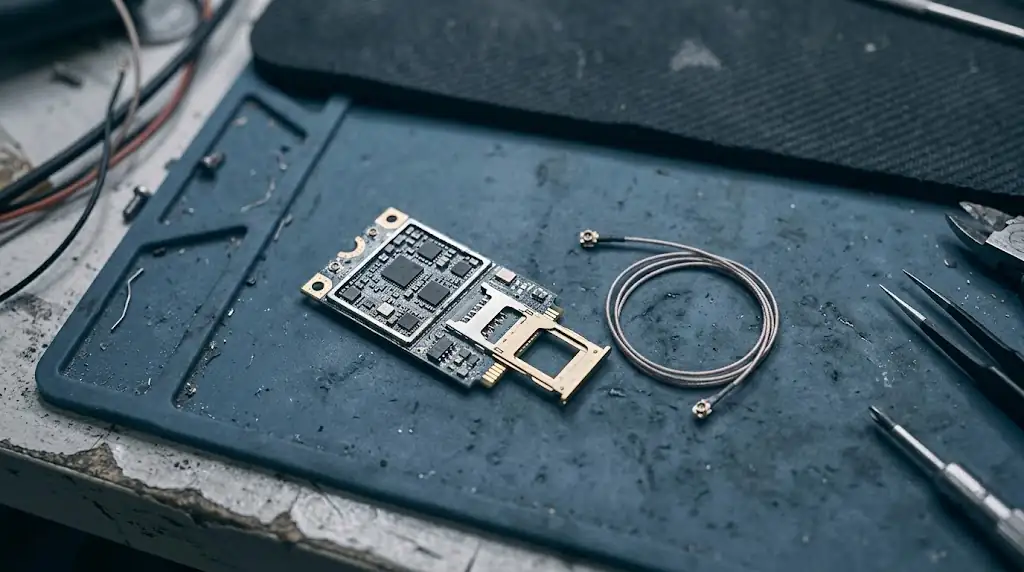
This is the part that has genuinely improved. Hatton identifies the mechanism directly: newer eSIM specifications “allow for much easier recredentialling of SIMs to a local profile.”
Recredentialling means the identity the module presents to the network can be replaced remotely. A machine in a market that starts requiring a local profile can be moved onto one without a service visit, a shipment or a hardware change.
That capability has to be designed in. A module with a carrier fixed in hardware offers two options when a market closes: send an engineer to every unit, or lose the connection. Neither is a plan. The wider version of this decision, and why it is so hard to reverse, is covered in how manufacturers choose connectivity for equipment they ship.
Your Distributor Is the Only One Who Knows
The other export problem is organisational. In most overseas markets the manufacturer sells through a distributor who handles installation, service and the customer relationship.
That arrangement is usually the right one commercially. It also means the manufacturer’s entire view of the market is filtered through a partner whose reporting is a favour rather than an obligation, and who has no particular reason to tell you about problems they have already solved.
So failures get fixed locally and never reach engineering, warranty patterns in one region stay invisible, and the first sign that a market is going badly is often a drop in orders. The mechanics of this, and why asking distributors to report harder does not work, are set out in how manufacturers see what happens in their dealer network.
What to Settle Before You Export
A short set of questions separates manufacturers who find export manageable from those who find it painful.
Can the connection be moved to a different carrier or a local profile without physical access to the machine? Do you know which units are in which country right now, as opposed to which country they were shipped to? If a machine stops reporting, can you tell the difference between switched off, out of coverage and disconnected by a regulator? And does anything reach you from that market other than parts orders and complaints?
None of these are answerable after the fact. They are all determined by choices made before the first container leaves.

Where ARMOR™ Fits
ARMOR™ is built on eSIM with multi-carrier support, including AT&T and T-Mobile, which is the design pattern this problem requires. The connection is not welded to one carrier relationship for the life of the machine.
ARMOR 4+™ reports runtime hours, location and electrical health into ARMOR Asset Central™, so a machine in another country maintains its own record rather than depending on a distributor to supply one. The same record can be shared with that distributor, which is usually a better relationship than asking them for reports.
The unit installs non-destructively using standard wiring harnesses, with no bill-of-materials redesign, which matters more for export variants than for domestic ones because regional configurations multiply quickly. How this is built in at the production stage is described on the ARMOR™ for Equipment Manufacturers page.
Frequently Asked Questions
Can we just fit a local SIM in each export market?
You can, and for a small number of markets it works. It becomes unmanageable as variants multiply, it fixes the configuration at the point of manufacture when you may not know the final destination, and it offers nothing when a machine is resold across a border.
Does this apply to equipment that has no cellular connection at all?
The regulatory part does not. The visibility part applies more, not less. An unconnected machine in an export market is known only through whatever your distributor chooses to report, which is the weakest position of all.
Is satellite a better option for remote markets?
For genuinely remote deployments it can be, and it carries its own cost and hardware implications. For most industrial equipment sold into populated areas, cellular coverage is adequate and the real problem is regulatory rather than physical.
Our distributor says they handle all of this. Is that enough?
For day to day service it often is, and a good distributor is a real asset. What it does not give you is the engineering and warranty picture from that market, because the information stops with whoever fixed the machine.
See how ARMOR™ is built into equipment like yours, at the build stage. ARMOR™ for Equipment Manufacturers