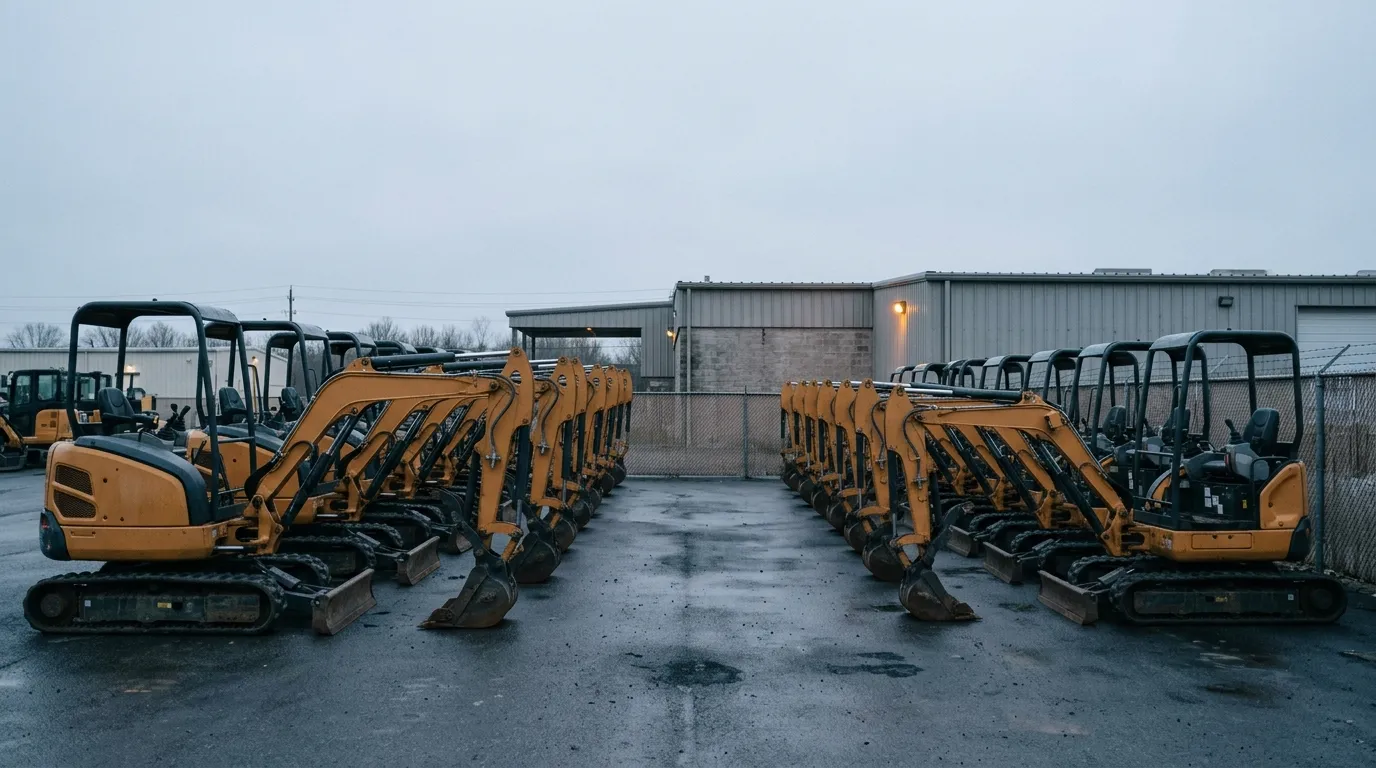
Most equipment reaches its first owner through a dealer, and most dealers do not pay for their stock with their own money. They borrow against it, one machine at a time. The lender’s protection is a simple and labour-intensive routine: someone visits the dealer and counts the machines. The US Office of the Comptroller of the Currency sets out the standard in its Comptroller’s Handbook on floor plan lending. Checks should include “verification of serial numbers, and comparison with any inventory lists to determine the inventory’s existence and condition and to confirm that the inventory is available for sale.”
That sounds like business between the dealer and the bank. It is also the manufacturer’s business, more often than the paperwork makes obvious.
Key Takeaways
- Floor plan lenders verify dealer stock by visiting the lot and matching serial numbers, usually at least once a quarter.
- Manufacturers are often party to the arrangement through repurchase or recourse agreements, so unaccounted stock can come back to them.
- Units out on demonstration, away for repair, or sold but not paid for are the situations a periodic count handles least well.
- Machines that report their own location and runtime let the manufacturer see the state of its dealer stock between checks.
 How Floor Plan Financing Works
The handbook describes floor plan lending as inventory financing “in which each loan advance is made against a specific piece of collateral.” Among the items it lists as commonly financed this way are construction equipment and agricultural equipment, alongside trucks, boats and recreational vehicles.
The mechanics are straightforward. In a typical arrangement, the lender pays the manufacturer when a machine is shipped to the dealer. The machine sits on the lot as collateral. When it sells, the dealer repays that advance. If it does not sell within an agreed period, the agreement usually requires the dealer to start paying down the loan anyway, a reduction the industry calls a curtailment.
The handbook is candid about the risk in this model: “Dealers are usually highly leveraged because of the need to maintain large amounts of inventory.” A dealer’s largest asset and largest liability are the same machines. When the machines and the loans stop matching, someone is exposed.
Why the Manufacturer Is in the Agreement
Floor plan financing for new stock usually involves three parties: the manufacturer, the dealer and the lender. The handbook notes that a floor plan facility “often includes an agreement from the supplier/manufacturer to repurchase unsold inventory within specified time limits.” Under a manufacturer repurchase agreement, “the manufacturer agrees to take back its merchandise under certain circumstances, such as for inventory remaining unsold after a specified period of time.”
Manufacturers also shape the economics in other ways. The handbook mentions manufacturers offering “to pay the dealers’ interest costs during certain inventory marketing or promotional periods.” Some manufacturers run their own captive finance companies and are the lender.
Whichever form it takes, the effect is the same. If stock on a dealer’s lot is not where the paperwork says, has been used, or has gone, part of the cost can travel back up the chain to the company that built it. A manufacturer with repurchase obligations has a direct interest in knowing what is really on its dealers’ lots.
 What a Floor Plan Check Looks For
The handbook expects lenders to check inventory “at least quarterly,” and more often where the risk is higher. Loans repaid on a “pay as sold” basis should generally be inspected more often, such as monthly. Visits should include “both pre-announced and unannounced” checks, and the check sheets should show that a bank representative has “personally verified every piece of inventory, by serial number and description.”
That is a physical count of every financed unit, by serial number, several times a year, at every dealer location. It is thorough, and it is a snapshot. Between visits, the lender and the manufacturer see only what the dealer reports.
Sold Out of Trust
The risk the checks are designed to catch has a name. The handbook defines it plainly: “A dealer sells out of trust when the inventory is sold and the funds are not immediately remitted to the bank to retire the corresponding debt.” It adds that this “usually occurs when the dealer is experiencing cash flow shortages or critical financial problems.”
The handbook also describes a subtler version. If inventory is missing at an inspection “and the dealer then remits, it is a sign that the dealer may be taking advantage of a float,” using the money from units sold weeks earlier. It warns as well that slow-moving inventory, “other than farm equipment or other seasonal merchandise, could be a sign of fraud or poor management.”
Each of these situations leaves a trace in the machines themselves. A unit sold out of trust has left the lot. A unit financed as new stock but working on a customer site has hours on it. A count every quarter finds these things late, while a connected machine records them as they happen.
The Units a Count Cannot See
Not every unit is on the lot when the inspector arrives, and not every absence is a problem. The handbook recognizes that dealers “may send inventory off the lot or out of the warehouse for demonstration purposes or possibly for minor maintenance issues,” and allows the lender to ask the dealer to produce such goods “within a reasonable time, e.g., two days.”
For demonstration and loaner vehicles, it says mileage should be checked “to confirm that depreciation is not occurring at a rate faster than expected.” The equivalent for equipment is hours. A new machine used for demonstrations, short-term rental or a customer trial is losing value with every hour it runs, and that value is the lender’s collateral and, potentially, the manufacturer’s repurchase exposure.
An inspector reading an hour meter on the day of the visit learns how many hours a machine has. They do not learn when those hours were put on it, where, or whether it will be back on the lot next week.
What the Manufacturer Can See Between Checks
If dealer stock reports its own location and runtime, the gaps between checks fill in. A new unit that has not moved and has not run is what the floor plan says it is. A unit with climbing hours is being used. A unit that has left the dealer’s location has either been sold, sent somewhere, or gone missing, and each of those has a different consequence.
This does not replace the lender’s inspection. The handbook expects lenders to verify collateral, and it cautions that third-party inventory audit services “should not be relied on without proper oversight by bank management.” What machine data can do is direct attention to the units and dealers that warrant it, and give all three parties the same facts when a question comes up. The same shared view of the dealer network is the subject of how manufacturers can see what happens in their dealer network.
Any arrangement like this needs to be agreed openly with dealers and lenders, with clear rules about who sees what.
 Where ARMOR™ Fits
ARMOR™ gives a manufacturer a record of where its connected units are and whether they have run. ARMOR 4+™ wires into the machine’s electrical system and reports runtime hours, voltage and current into ARMOR Asset Central™, the system of record for runtime, location, condition and activity, so a new unit on a dealer’s lot can be seen to be sitting idle, accumulating hours or no longer there.
ARMOR™ does not inspect inventory, decide whether a dealer has sold out of trust, or replace a lender’s checks. It supplies the facts that make those checks better aimed and the conversations after them shorter.
The unit installs non-destructively on standard wiring harnesses, with no bill-of-materials redesign. How it is built in at the production stage is set out on the ARMOR™ for Equipment Manufacturers page.
Frequently Asked Questions
Can machine data replace a physical floor plan check?
Not on its own. The OCC handbook expects lenders to verify inventory, and whether a lender gives weight to machine data is the lender’s decision. Data is most useful for showing where checks should focus and for resolving questions between visits.
Will dealers object to the manufacturer seeing their stock?
Some may, which is why it should be agreed in advance and applied evenly. The same record also protects a dealer, because it shows that a unit was on the lot, idle, when a question is later raised about it.
Does this matter if we do not run a captive finance company?
It can. Repurchase and recourse agreements with independent lenders can still bring unsold or misused stock back to the manufacturer. Review your own agreements to see where your exposure sits.
What about used equipment on the dealer’s lot?
The handbook notes that for pre-owned inventory, “manufacturers may be absent from the floor plan lending arrangements.” A connected trade-in still carries its own history, which matters to the dealer and the lender even when the manufacturer is not a party.
See how ARMOR™ is built into equipment like yours, at the build stage. ARMOR™ for Equipment Manufacturers