Key Takeaways
- Manufacturing leads every other industry in IoT adoption, accounting for 34% of total device deployments (2026 industry data).
- Connected equipment turns predictive maintenance from a once-a-quarter inspection into a continuous, data-backed process.
- Predictive maintenance already reduces unplanned downtime by 28% on average across manufacturing.
- The average factory floor now runs about 178 sensors per 10,000 square feet, a density that demands real integration, not isolated dashboards.
What Does “Connected Equipment” Actually Mean in Practice?
Connected equipment is any machine, vehicle, or asset that reports its own operating data back to a system instead of waiting for someone to walk over and check it. That’s a simple definition covering a wide range of maturity, from a single sensor bolted onto an old compressor to a factory floor where every endpoint reports into one unified platform.
The gap between those two ends of the spectrum is where most of the value sits. A lone sensor tells you one thing about one machine. A connected fleet tells you patterns across your whole operation, and patterns are what actually change decisions.
How Widely Adopted Is Connected Equipment Right Now?
More than most people assume. Manufacturing leads every other sector in IoT adoption, representing 34% of total device deployments in 2025 (2026 industry data). Within that footprint, process automation is the single most common use case at 58% adoption, ahead of predictive maintenance and supply chain visibility.
That density is real on the floor, too. The average facility now runs roughly 178 sensors per 10,000 square feet, covering everything from equipment performance to ambient environmental conditions (2026 industry data). At that scale, connectivity stops being a nice-to-have layer and becomes core infrastructure, on par with power and networking.
The broader market reflects that shift. IoT spending in manufacturing was valued at $141.18 billion in 2025 and is forecast to reach $172.65 billion by the end of 2026 (2026 industry data), en route to over $1 trillion by 2034.
What’s the Real Payoff for Field Service Teams?
Fewer surprise calls. Connected equipment moves service from reactive, “something broke, send someone,” toward proactive scheduling built around actual machine condition. Predictive maintenance built on connected equipment data reduces unplanned downtime by an average of 28% (2026 industry data), which compounds across a field service team’s calendar fast.
That shift also changes what a service visit looks like. A technician walking in already knowing which component is degrading spends less time diagnosing and more time fixing, which shortens the visit and lowers the cost per call.
Are Manufacturers Actually Using the Data They Collect?
Increasingly, yes, and increasingly with AI layered on top. Among the 223 manufacturing sites tracked in the World Economic Forum’s Global Lighthouse Network, generative AI made up 23% of the top five deployed use cases in 2025, up sharply from just 9% the year before. Those same sites report connecting an average of 85% of their production and logistics endpoints into unified IT and operational systems, which is what makes that AI layer possible in the first place.
None of that generative AI or analytics runs without the connected equipment underneath it feeding clean, structured data. The connectivity is the unglamorous part, but it’s the part that makes everything built on top of it possible.
What Should a Team Look for Before Connecting a New Fleet of Equipment?
Three things separate a connected equipment rollout that sticks from one that stalls:
- A single source of truth. Mixed fleets from different manufacturers each speak their own dialect. Standardizing that data on the way in avoids five separate logins to check five separate machines.
- Edge processing for time-sensitive alerts. Not every signal needs to travel to the cloud before it matters. Critical alerts should trigger locally, with trend analysis happening in the cloud afterward.
- A plan for scale from day one. Connecting ten machines and connecting a thousand require different architecture. Building for the smaller number first, without a path to the larger one, usually means rebuilding later.
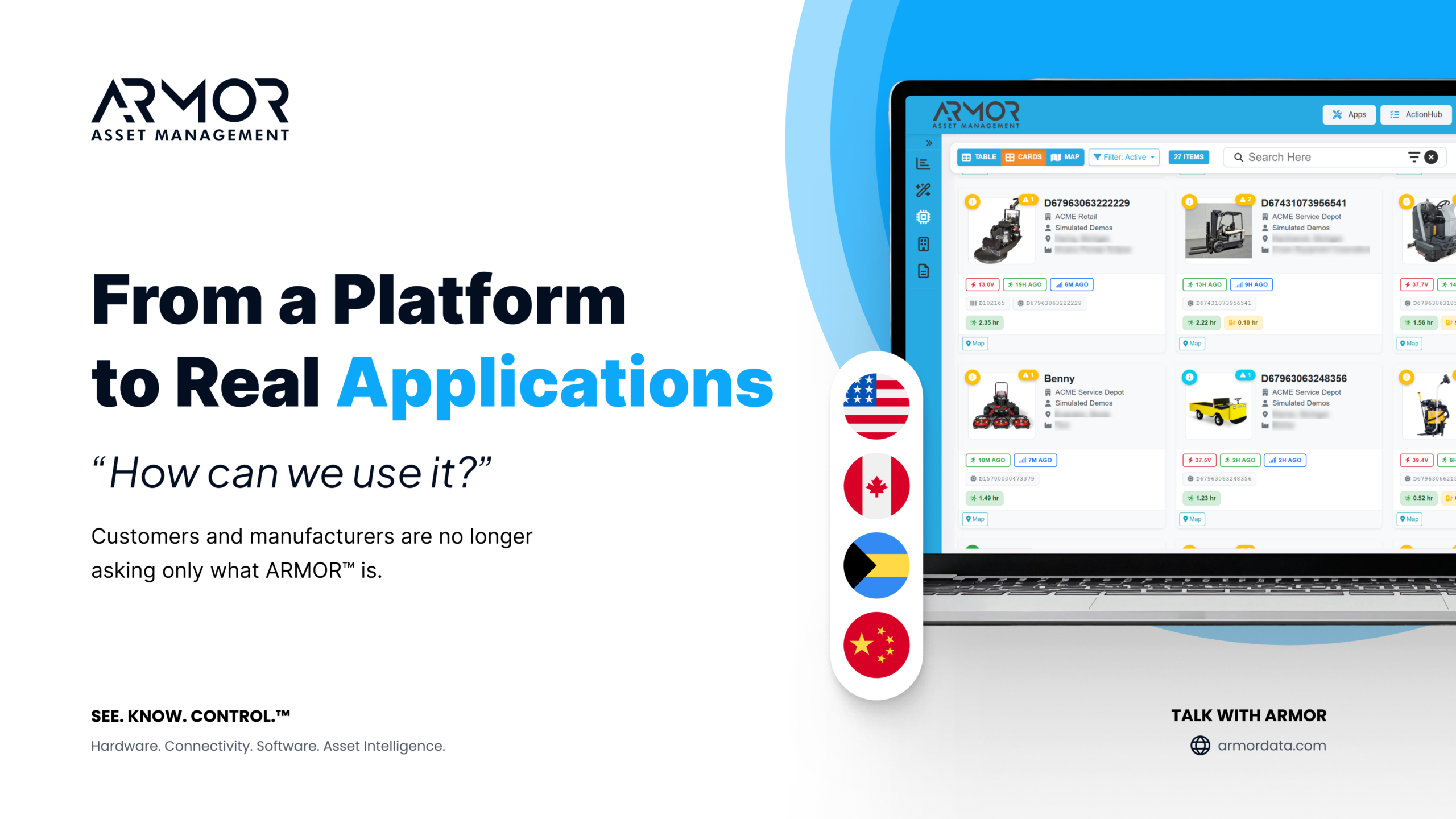
ARMOR™ standardizes that intake layer across manufacturers and asset types, so a mixed fleet reports through one system instead of five separate portals.
Frequently Asked Questions
Is connected equipment the same thing as OEM IoT?
They overlap but aren’t identical. Connected equipment describes the outcome, a machine that communicates its own data. OEM IoT describes one path to that outcome, where connectivity gets built in at the factory rather than retrofitted afterward.
What industries have the highest connected equipment adoption?
Manufacturing leads at 34% of deployments, with healthcare IoT growing fastest overall at roughly 32.5% compound annual growth as remote monitoring use cases expand (2026 industry data).
Does connecting older equipment require replacing it?
Usually not. Retrofit sensor kits can add connectivity to existing machines, though newer equipment increasingly ships with connectivity built in from the OEM.
How much data does connected equipment actually generate?
At scale, a lot. Global IoT devices are estimated to generate close to 79.4 zettabytes of data annually, which is why edge processing and clean data pipelines matter as much as the sensors themselves.
Explore ARMOR™ Solutions
- About ARMOR™, learn more about the platform standardizing intake across mixed equipment fleets. Contact Us
- Asset Central, full details on the unified dashboard for tracking equipment health across sites.
- Beacon, edge-level alerting for the time-sensitive signals discussed in the scaling section.
- Track, asset-level monitoring built for predictive maintenance use cases like those covered here.
- Security Statement, how ARMOR™ stays off your corporate network.