Key Takeaways
- Original equipment manufacturers are shifting connectivity from an aftermarket add-on to a factory-line standard.
- IoT in manufacturing is forecast to grow from $141.18 billion in 2025 to $172.65 billion by the end of 2026.
- Embedded connectivity turns equipment aftermarket service from a cost center into a recurring revenue stream.
- Manufacturers who skip embedded connectivity now are choosing to retrofit later, usually at higher cost.
What Is OEM IoT, and Why Is It Different From Bolt-On Sensors?
OEM IoT means the connectivity is designed into the machine at the point of manufacture rather than added afterward by the buyer or a third party. The sensor isn’t a retrofit kit zip-tied to a control panel. It’s part of the original engineering, wired into the machine’s own control system from day one.
That distinction matters because factory-embedded connectivity tends to be more reliable, better integrated with the machine’s native diagnostics, and cheaper per unit at volume than retrofitting thousands of machines individually after they’re already in the field.
Why Are OEMs Moving Toward Embedded Connectivity Now?
Because the aftermarket has quietly become one of the most valuable parts of the equipment business, and it’s underperforming without data. For decades, OEMs poured most of their digital investment into product design and manufacturing efficiency, while service and support after the sale stayed fragmented and reactive.
That’s changing fast. Sensors embedded in machines now stream operational data directly back to the manufacturer, giving OEMs visibility into how equipment performs in the field regardless of geography or customer size (2026 industry data). That data turns a service call from a reactive phone conversation into a proactive, scheduled process, and it gives OEMs a foundation to build branded digital experiences their customers and internal teams actually use.
The market backs up the shift in priority. IoT in manufacturing was valued at $141.18 billion in 2025 and is projected to reach $172.65 billion by the end of 2026, on its way to more than $1.1 trillion by 2034 (2026 industry data). North America alone accounts for roughly $42.3 billion of that 2025 total.
How Does Embedded Connectivity Change the Aftermarket Business Model?
Fundamentally. Aftermarket service, parts, and support have historically been treated as a cost of doing business rather than a growth opportunity. Embedded connectivity flips that, because OEMs that connect their equipment and centralize the resulting data can turn aftermarket into a scalable, recurring revenue engine rather than a reactive expense line (2026 industry data).
That shift plays out across a wide range of equipment categories, not just heavy industrial machinery. Even vending machines and self-service kiosks increasingly ship with embedded connectivity so operators can manage payments, restocking, and promotions across a distributed fleet without visiting every unit in person (2025 industry data).
What Should an OEM Weigh Before Committing to Embedded Connectivity?
A few decisions shape whether an embedded IoT program pays off or turns into an expensive science project:
- Connectivity type. LTE-M, 5G RedCap, satellite NTN, and eSIM each fit different use cases depending on deployment environment and expected device lifespan, which for industrial equipment can run past ten years.
- Data ownership and access. Decide early who sees what: the OEM, the equipment owner, and any third-party fleet management platform the customer already uses.
- Security posture from day one. Zero Trust architecture, over-the-air update capability, and long-term compliance support all matter more once a machine is in the field for a decade, not a device cycle of two or three years.
- A plan for supply constraints. Lead times for the microcontrollers behind many embedded IoT designs stretched to 26 weeks in 2025 as foundries prioritized other markets, pushing some OEMs to redesign boards around alternative chips (2026 industry data).
ARMOR™ works alongside OEM telemetry rather than replacing it, giving equipment owners one place to see embedded machine data next to service history and parts availability, regardless of which manufacturer built the machine.
Frequently Asked Questions
Is OEM IoT only relevant for large manufacturers?
No. Smaller OEMs increasingly compete on the same connected-service expectations as larger rivals, especially as customers get used to real-time visibility from at least some of their equipment vendors.
Does embedded connectivity replace third-party fleet management platforms?
Not usually. Most equipment owners run mixed fleets from multiple OEMs, so a platform that unifies embedded data across manufacturers still adds value even when individual machines already report their own telemetry.
How long does OEM embedded connectivity typically last on industrial equipment?
Enterprise and industrial buyers now generally expect ten-plus year device lifecycles, which shapes decisions around connectivity type, firmware update support, and long-term data plan costs.
What’s driving the current supply chain pressure on IoT hardware?
Foundries have prioritized advanced chip nodes for smartphones and AI accelerators, stretching lead times for the mature-node microcontrollers many IoT devices rely on, with new capacity not expected to reach volume production before 2028.
Explore ARMOR™ Solutions
- About ARMOR™, learn more about the platform standardizing intake across mixed equipment fleets. Contact Us
- Asset Central, full details on the unified dashboard for tracking equipment health across sites.
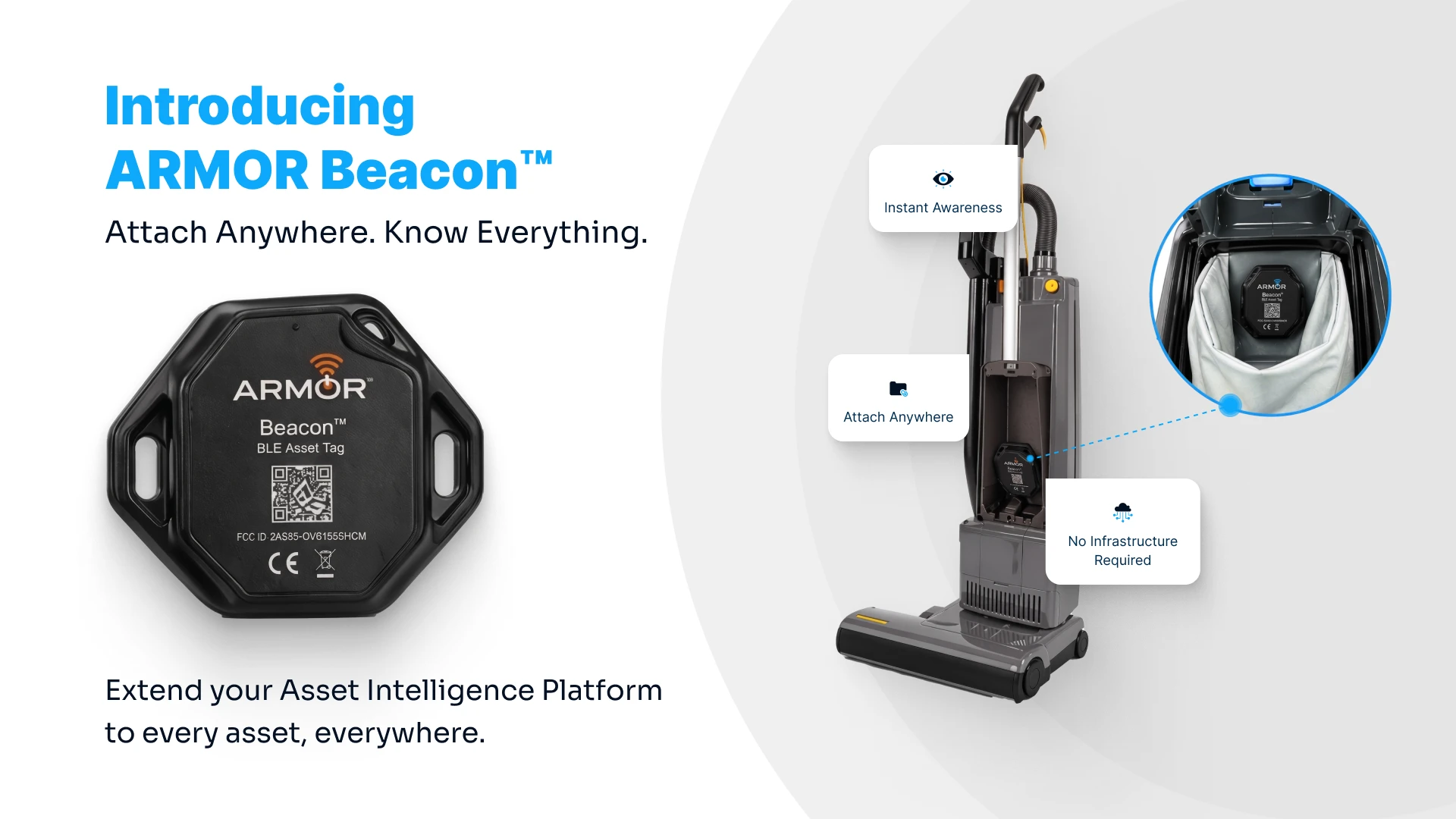
- Beacon, edge-level alerting for the time-sensitive signals discussed in the scaling section.
- Track, asset-level monitoring built for predictive maintenance use cases like those covered here.
- Security Statement, how ARMOR™ stays off your corporate network.