Key Takeaways
- Nearly half of manufacturers still have no way to pinpoint equipment inside their own facilities (2025 industry data).
- Operators can lose several hours a day hunting for carts, tools, and semi-finished batches when location data doesn’t exist.
- Location technology (UWB, BLE, sensor fusion) is increasingly paired with predictive maintenance rather than deployed alone.
- Real-time location data feeds directly into scheduling, safety, and compliance, not just “where is it right now.”
Why Do So Many Facilities Still Lose Track of Equipment Indoors?
A 2025 OpinionWay survey found that only 49% of manufacturers report having at least one geolocation technology deployed on site (2025 industry data), which means over half are still working without one. That gap isn’t really a technology problem anymore. It’s a visibility gap that shows up every shift, in every aisle.
A forklift gets parked in the wrong bay. A cart of finished parts sits behind a pallet nobody checks. A technician spends twenty minutes walking the floor for a tool that moved an hour ago. None of that shows up on a P&L line, but it adds up fast across a plant running two or three shifts.
Analysts increasingly describe this as an untapped source of operational efficiency, since facilities that can’t locate assets indoors also tend to struggle with traceability, safety coordination, and handoffs between shifts (2025 industry data).
What’s Actually Changed in Indoor Location Technology?
Ultra-wideband, BLE beacons, and sensor fusion have moved from pilot projects into production deployments. What’s different in 2026 is how these technologies get used once they’re installed.
Predictive maintenance has become one of the core pillars of indoor location strategy, largely because industrial IoT, edge computing, and embedded AI have turned nearly every critical asset, from a forklift to a storage system, into a continuous data source (2025 industry data). A location tag isn’t just answering “where is it.” Paired with condition data, it starts answering “is it healthy, and is it where it’s supposed to be right now.”
That combination is a big part of why the underlying market keeps growing. IoT-based location and monitoring platforms are projected to expand from $5.52 billion in 2025 to $6.3 billion in 2026, a 14.3% compound annual growth rate (2026 industry data), driven by supply chain digitization and the push for full asset visibility.
Where Does the Time Actually Go Without Location Data?
Ask a plant manager how long a shift loses to searching, and the honest answer is usually “more than I’d like to admit.” Time spent locating carts, skips, and semi-finished batches can run into several hours per operator, per day, in facilities without indoor location coverage (2025 industry data).
Multiply that across a hundred-person floor and the math gets uncomfortable fast. It’s rarely one big loss. It’s dozens of small ones that never get logged anywhere, which is exactly why they’re hard to fix without data behind them.
Adoption is picking up because of it. Roughly 64% of enterprises have already shifted to real-time visibility of equipment and fleet assets, and 47% report reduced operational losses through the automation that follows (2026 industry data).
How Should a Facility Start Rolling Out Indoor Asset Visibility?
Start narrow. Pick the one asset class causing the most search time, whether that’s mobile equipment, tooling carts, or WIP totes, and instrument that first. A phased rollout beats a big-bang deployment because it lets the team validate accuracy and workflow fit before scaling site-wide.
Three things matter most in that first phase:
- Coverage that matches the floor plan. Dense metal racking and heavy machinery interfere differently with UWB versus BLE. Test both in the actual environment, not a demo room.
- Data that reaches the people who need it. A dashboard nobody opens during a shift doesn’t save anyone time. Location data needs to land in the tools operators already use.
- A path to condition data. Location is the entry point. The bigger payoff comes when that same infrastructure carries usage hours, temperature, or vibration data.
ARMOR™ is built toward that third step by design, so the location layer deployed today becomes the foundation for the condition data a team will want next year.
What Does This Look Like at Enterprise Scale?
For multi-site operators, the challenge shifts from “can we locate this one asset” to “can we compare asset performance across every site using the same standard.” That’s where enterprise-grade asset management platforms earn their keep, standardizing how location, usage, and maintenance data get captured so a plant in Ohio and a plant in Texas report the same metrics the same way.
North America continues to lead adoption here, largely because established logistics and manufacturing infrastructure makes rollout faster than in newer markets (2026 industry data).
Frequently Asked Questions
What’s the difference between locating an asset and having full asset visibility?
Locating an asset usually means a dot on a map. Full visibility layers in condition, usage history, and status, giving teams enough context to act instead of just observe. Global connected-device counts were on pace to hit roughly 30 billion units by 2025 (2025 industry data), and most of the value comes from combining several data streams, not relying on just one.
Is UWB or BLE better for indoor location?
Neither wins outright. UWB delivers tighter accuracy, often sub-meter, but costs more per tag. BLE is cheaper and easier to deploy at scale but trades off some precision. Most facilities pilot both against their actual floor plan before committing to one.
How fast is this market growing?
The global market for IoT-based location solutions was valued near $4.67 billion in 2025 and is projected to more than double by the early 2030s, a compound annual growth rate near 13% (2026 industry data), reflecting how quickly this moved from niche to standard practice.
Does indoor location data help with compliance?
Yes. Knowing where an asset was, and when, supports audit trails for safety inspections, calibration schedules, and chain-of-custody requirements, particularly in regulated manufacturing environments.
Explore ARMOR™ Solutions
- About ARMOR™, learn more about the platform standardizing intake across mixed equipment fleets. Contact Us
- Asset Central, full details on the unified dashboard for tracking equipment health across sites.
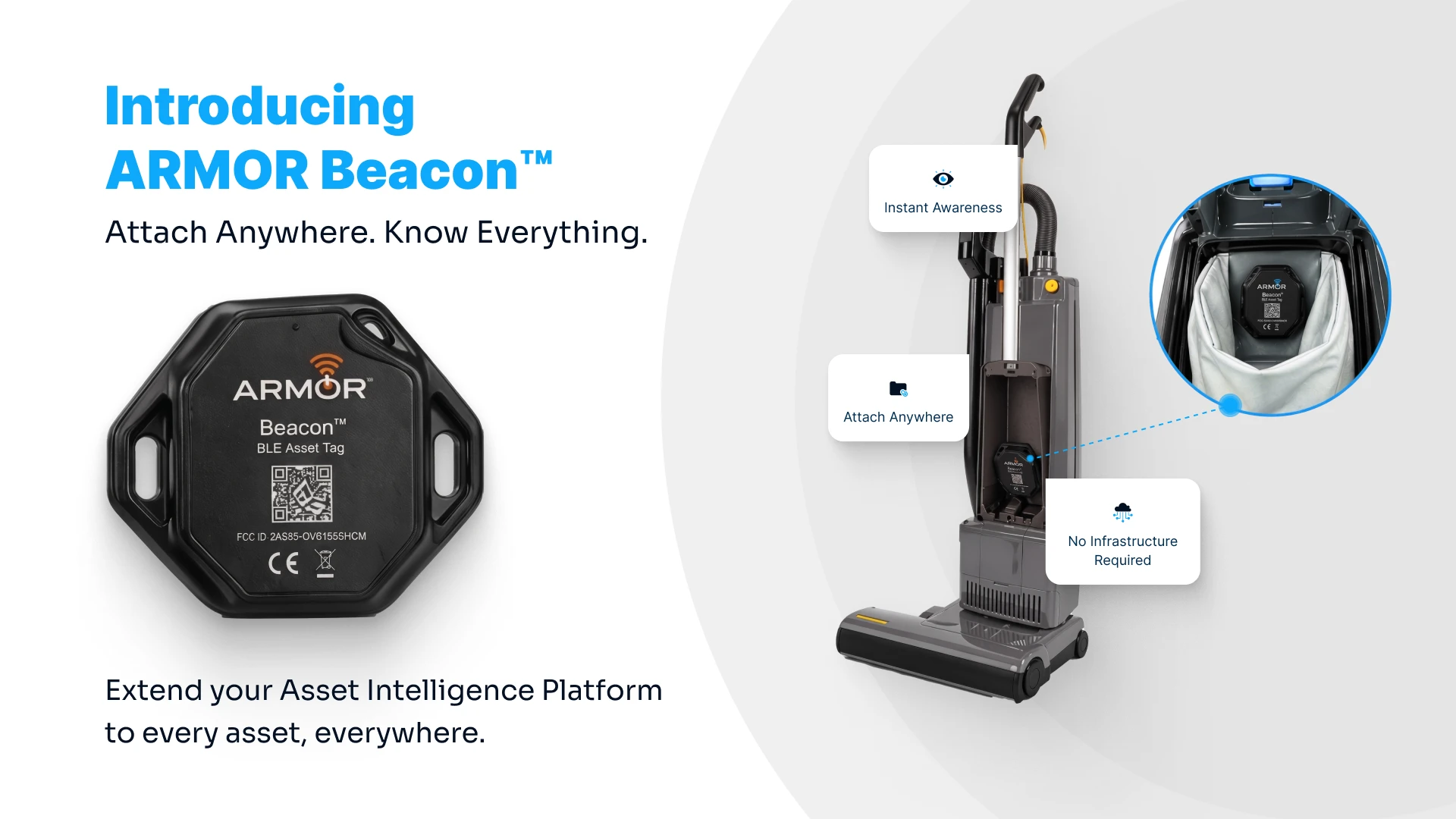
- Beacon, edge-level alerting for the time-sensitive signals discussed in the scaling section.
- Track, asset-level monitoring built for predictive maintenance use cases like those covered here.
- Security Statement, how ARMOR™ stays off your corporate network.